Introduction
Rossmax Fingertip Pulse Oximeter SB220 is used
to measure arterial oxygen saturation (% SpO2) of
hemoglobin and pulse rate, an important indicator
of your respiratory function. It is non-invasive device
intended for spot-check of adult and pediatric whose
age is over 3 at home, hospital and clinics.
Attention: Consult the accompanying
documents. Please read this manual carefully
before use. Please be sure to keep this manual.
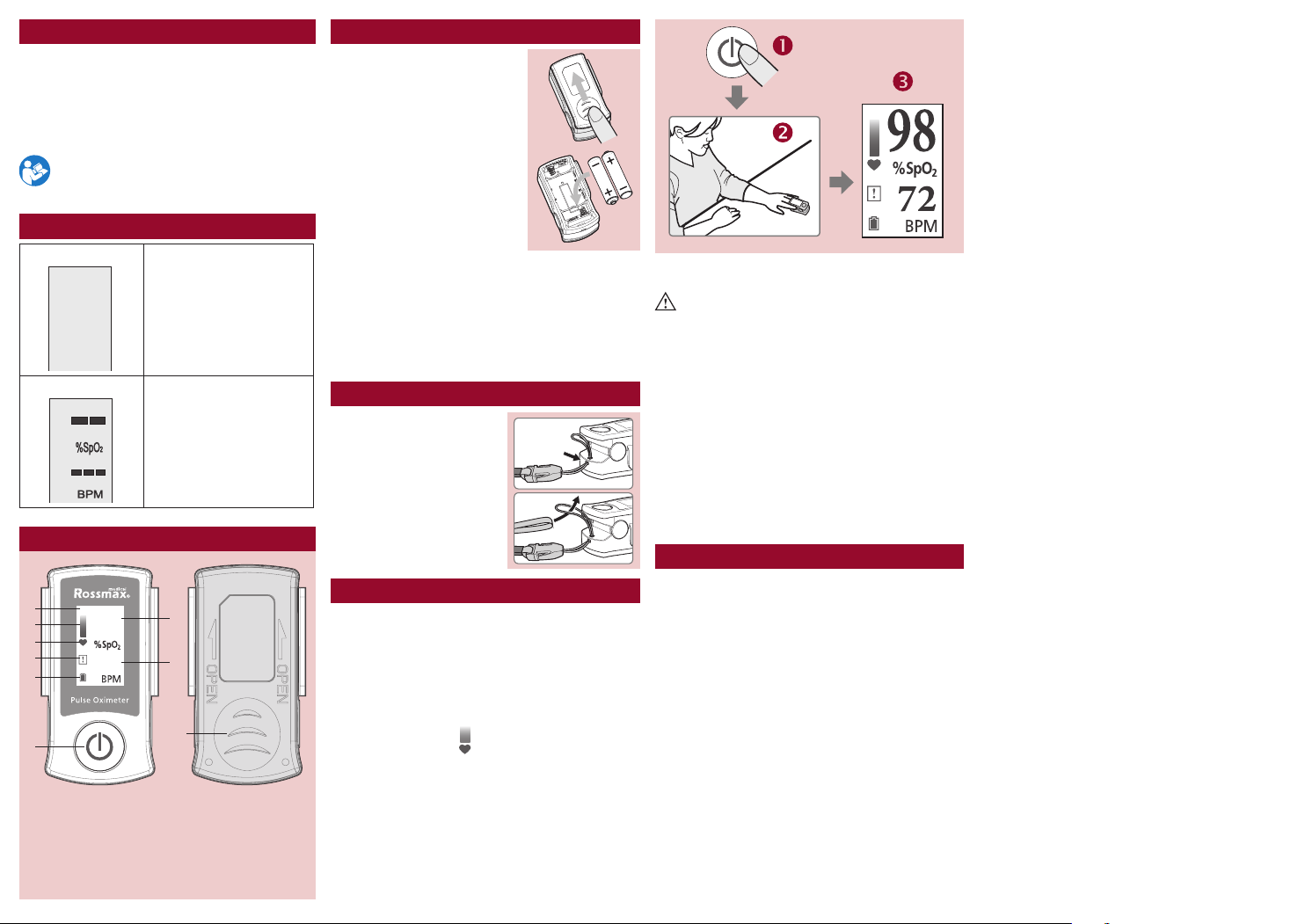
Installing Batteries
Error code for your reference
1. Use thumb to slide battery cover
out.
2. Insert or replace 2 “AAA” sized
batteries down with the correct
electrical polarity.
You need to replace the batteries
when:
1. Low battery icon appears on
display
2. The function button is pressed
and nothing appears on display.
Caution:
Batteries may leak or explode if
used or disposed of improperly. Remove batteries if the
device will be stored for long time. Do not use different
types or brands of batteries at the same time. Do not
mix fully charged and partially charged batteries at the
same time. The device will automatically shut down in
low battery.
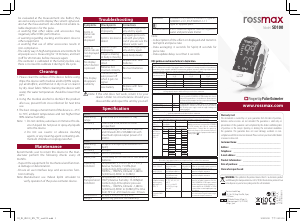
SENSOR ERROR:
Er
Sensor cannot be detected,
return the device to your
local distributor or service
centre.
MEASURE ERROR:
Signals cannot be detected,
turn the device off and meas-
ure again.
Attaching the lanyard
1. Insert the narrow end of the
lanyard through the holder.
2. Draw the other end of the
lanyard through the loop
at the narrow end and
tighten.
How to use
1. Open the clip; press the Power On/Off button as .
2. Information of software version appears. Insert one
finger(left hand middle finger is recommended), nail
side up, into the finger opening of the pulse oximeter
as .
Note: If no finger insert, the device will auto shut off
after 8 seconds.
3. The display shows
, pulse oximeter begins its
measurement.
Note: Make sure the finger is lying flat. Do not shake
and keep body steady during measurement.
4. Your SpO
2
and pulse rate values will appear on the
screen after few seconds as .
Note: 1. Don’t remove your finger until the measurement
is completed.
2. While pulse strength is low, the reading will
flicker.
Cautionary Notes
- This device is to be operated by trained personnel only.
- The device has intended only for spot-checking, but not
medical result evaluation.
- This device is designed to determine the percentage of ar-
terial oxygen saturation of functional hemoglobin. Factors
that may degrade pulse oximeter performance or aect
the accuracy of the measurement include the following:
• Do not apply the pulse oximeter on the same arm as a
blood pressure cu, arterial catheter or infusion line(s).
• Excessive light, such as sunlight or direct home lighting.
• Not steady at the site of application (e.g. trembling).
• Moisture in the device.
• Improperly applied device.
• Finger is too large or too small to t into the device.
• Poor pulse quality.
• Venous pulsations.
• Anemia or low hemoglobin concentrations.
• Cardiogreen and other intravascular dyes.
• Carboxyhemoglobin.
• Methemoglobin.
• Dysfunctional hemoglobin.
• Articial nails or ngernail polish.
• On ngers with anatomical changes, oedemas, scars
or burns.
- Using the device for long periods may cause pain for
people with circulatory disorders. Reposition the device
at least once every 4 hours to allow the patient’s skin to
breath and to check patient’s condition regularly.
- Do not use the device near ammable or explosive gas
mixtures.
- Do not use the device during an MRI or CT scan, be used
no closer than 30 cm (12 inches) to any part of the SpO2
device, including cables specied by the manufacturer.
- The device may not work when circulation is reduced.
Warm or rub the nger, or re-position the device.
- This device is a precision electronic instrument and must
be repaired by qualied technical professionals. Field re-
pair of the device is not possible. Do no attempt to open
the case or repair the electronics. Opening the case may
damage the device and void the warranty.
- Do not overextend the device’s spring.
- A functional tester cannot be used to access the accu-
racy of a pulse oximeter monitor.
- Do not self-diagnose or self-medicate on the basis of
the measurements without consulting your doctor. In
particular, do not start taking any new medication or
change the type and/or dosage of any existing medica-
tion without prior approval.
- Do not look directly inside the housing during the meas-
urement. The red light and the invisible infra-red light in
the pulse oximeter are harmful to your eyes.
- This device is not intended for use by people (includ-
ing children) with restricted physical, sensory or mental
skills or a lack of experience and/or a lack of knowledge,
unless they are supervised by a person who has respon-
sibility for their safety or they receive instructions from
this person on how to use the device. Children should
be supervised around the device to ensure they do not
play with it.
- Neither of the displays for the pulse wave and pulse
bar allows the strength of the pulse or circulation to be
evaluated at the measurement site. Rather, they are ex-
clusively used to display the current signal variation at
the measurement site and do not enable reliable diag-
nostics for the pulse.
- The maximum temperature of sensors which the user
will touch might reach 43°C when operating in the 40°C
environment.
- The safety for user use in high-temperature environment
is measuring for 10 minutes, and turn it o for 20 min-
utes before measure again.
5. Press button shortly to reverse the display upside
down.
Note:
1. The SpO
2
sensor and photoelectric receiving tube
should be arranged in a way with the subject’s arteriole
in a position there between.
2. Make sure the optical path is free from any optical
obstacles like rubberized fabric.
3. Excessive ambient light may affect the measuring
result. It includes fluorescent lamp, dual ruby light,
infrared heater, direct sunlight and etc.
4. Strenuous action of the subject or extreme
electrosurgical interference may also affect the
accuracy.
5. The device has a visual and audio signal when the
measurement of SpO
2
is lower than 90%.
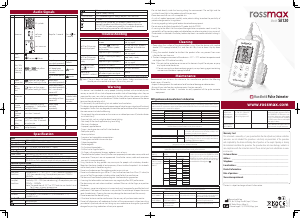
Name/ Functions of each part
1. OLED display
2. Pulse strength
3. Pulse search icon
4. Remind icon
5. Battery indicator
6. Power On/O Button
7. Battery compartment
8. Pulse rate icon
9. SpO2 icon
1
2
3
4
5
6
7
9
8


Praat mee over dit product
Laat hier weten wat jij vindt van de Rossmax SB220 Pulse-oxymeter. Als je een vraag hebt, lees dan eerst zorgvuldig de handleiding door. Een handleiding aanvragen kan via ons contactformulier.