Handleiding Vango Kalari 420 Tent

Handleiding voor je Vango Kalari 420 Tent nodig? Hieronder kun je de handleiding gratis bekijken en downloaden als PDF in het Nederlands en/of Engels. Dit product heeft 7 veelgestelde vragen, 0 comments en heeft 0 stemmen. Is dit niet de handleiding die je zoekt, neem dan contact met ons op.

Is je product kapot en biedt de handleiding geen oplossing meer? Dan kun je voor reparatie gratis terecht bij Repair Café.

Handleiding

Loading…

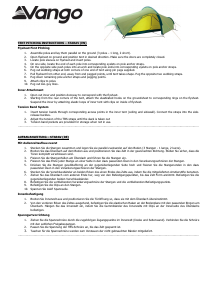
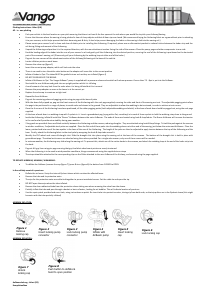
PITCHING INSTRUCTIONS KALARI (UK)
Pitching Instructions Kalari (UK)
All - in - one pitching
Park your vehicle in the best location on your pitch ensuring that there is at least 4.6m free space at the side where you would like to pitch your AirAway/Awning.
Ensure that the area where the awning is being pitched is clear of sharp objects and that all door zips are closed. (We recommend laying the AirAwning fabric on a groundsheet prior to attaching
it to your caravan, as this helps prevent the fabric becoming wet & dirty. It also helps prevent damaging the fabric as the awning is fed into the awning rail.)
Please ensure your caravan’s rail is clean and clear of debris prior to installing the AirAwning. If required, please use an aftermarket product to reduce friction between the kador strip and the
rail during fitting and removal of the AirAwning.
Unpack the AirAwning and position it in the required direction, with the rear attachment section facing the side of the caravan. Place the pump, pegs and other components to one side.
Feed the leading edge of the kador into the rear of your caravan’s rail and gently pull the AirAwning into the desired position, ensuring the roof of the AirAwning is positioned on the horizontal
part of the caravan’s awning rail. (Please only pull your AirAwning by the webbing loop at either end of the kador.)
Peg out the rear corners of the attachment section of the AirAway/AirAwning at the base of the vehicle.
Locate inflation points on each beam
Remove the valve cap (figure 1)
Insert the correct pump adaptor, which will lock onto the valve
There is no need to turn the white valve button as the adaptor will move this to the correct position
Inflate all tubes to 7psi. The tubes MUST be guided into an arch as they are inflated (figure 4)
DO NOT OVER-INFLATE THE BEAMS
Inflate all AirBeams to 7psi. The Vango AirBeam® pump is supplied with a pressure release valve which will release pressure if more than 7.5 - 8psi is put into the AirBeam.
Start with the rear AirBeam and guide into an upright position whilst it is inflating
A small amount of air may leak from the valve when it is being inflated but this is normal
Remove the pump adaptor as soon as the beam is at the correct psi
Replace the valve cap to create an air tight seal
Repeat for front AirBeam
Peg out the remaining poles and pegging points using pin pegs at the base of poles
With the doors fully zipped up, peg out the front corners of the AirAwning with the rock pegs supplied, ensuring the sides and front of the awning are taut. The adjustable pegging points allow
the pegs to be positioned in a range of places, to avoid rocks and stones in the ground. They are adjustable to allow the webbing to be tensioned, in order to achieve a taut canvas.
Once the 4 corners of the AirAwning have been positioned, all the other pegging points (both adjustable webbing and elastic) at the base of each door should be pegged out, using the rock pegs
supplied.
At the base of each door is a webbing strap with 2 eyelets in it. Insert a groundsheet peg (a peg with a flat, round top) in to each of these eyelets to hold the webbing strap close to the ground.
Inside the AirAwning, inflate & install the "Bracer" AirBeams between the main AirBeams. The ends of these are located using hook & loop fabrics. The Bracer AirBeams will increase the tension
in the roof and will provide extra stability during poor weather.
2 long pads are provided: these are fitted vertically between the AirAwning and the caravan, reducing draughts. They are attached using hook & loop fixings. To hold the pads against the caravan
in windier conditions, 2 adjustable steel poles are supplied. Place the flat end of these poles into the webbing sleeves at either end of the awning, just below the outermost AirBeams. Place the
lower, pointed end into one of the two eyelets in the base of the rear of the AirAwning. The length of the pole can then be adjusted to apply tension between the top of the AirAwning and the
base. Finally, attach the AirAwning fabric to the steel pole by wrapping the hook & loop tabs around it.
Identify the PVC wheel arch covers & draught skirt. Slide the draught skirt into place using the awning rail at the base of the caravan. The bottom of the draught skirt is held in place with
groundsheet pegs. The wheel arch covers are attached using the suckers provided. For a single axle caravan, only one of these covers will be needed.
In extreme weather, the AirAwning may slide along the awning rail. To prevent this, attach one of the sucker hooks to the caravan, and attach the webbing loop at the end of the kador strip into
the hook.
Peg out ALL guy lines using pin-pegs ensuring that guy line fabric attachment points are evenly tensioned.
When the AirAwning is to be used in windy weather conditions, Vango recommends using the supplied storm straps
The straps should be attached to the corresponding clips on the fillets attached to the rear AirBeam of the AirAway, and secured using the pegs supplied.
TO DEFLATE AIRBEAM/ AIRAWAY/ AIRAWNING:
To deflate the AirBeam (remove the cap (figure 7)) press & turn (figure 8) the button from CLOSED to OPEN
In the unlikely event of a puncture:
Deflate the air beam. Unzip the internal flysheet sleeve which contains the affected beam.
Remove the tube and its protective outer.
The zips for the protective outer are cable tied together to prevent accidental access. Cut the cable tie and open the zip.
DO NOT open these zips when the tube inflated.
Remove the clear rubberised tube from the protective sleeve taking care when removing the valve from the sleeve.
Partially inflate the tube and pass through a bucket or basin of water, looking for air bubbles. This will indicate location of puncture
Use the repair patch provided and cover hole, using instructions on patch. Re-insert tube into protective outer, closing zip from both ends, so that zip pullers are in the flysheet sleeve (this might
be easier with the tube partially inflated)
AIRBEAM INFLATION:
AIRBEAM DEFLATION:
Aufbauanleitung - Kalari (DE)
Komplettaufbau
Figure 1
Remove
locking cap
Figure 3
Lock locking pump
connector
Figure 4
Inflate with
AirBeam pump
Figure 5
Insert locking
cap
Figure 6
Lock locking cap
Figure 8
Push button to deflate &
twist to open position
Figure 7
Unlock
locking cap
Figure 2
Insert locking pump
connector
Download de handleiding in het Nederlands en/of Engels (PDF, 0.48 MB)
(Denk aan het milieu en print deze handleiding alleen als dat echt noodzakelijk is)

Loading…

Meer over deze handleiding

We begrijpen dat het prettig is om een papieren handleiding te hebben voor je Vango Kalari 420 Tent. Je kunt de handleiding bij ons altijd downloaden en daarna zelf printen. Indien je graag een originele handleiding wilt hebben, raden we je aan contact op te nemen met Vango. Zij kunnen wellicht nog voorzien in een originele handleiding. Zoek je de handleiding van Vango Kalari 420 Tent in een andere taal? Kies op de homepage je taal naar keuze en zoek daarna op het modelnummer om te zien of we deze beschikbaar hebben.

Specificaties

Merk Vango
Model Kalari 420
Categorie Tenten
Bestandstype PDF
Bestandsgrootte 0.48 MB

Alle handleidingen voor Vango Tenten
Meer handleidingen voor Tenten

Veelgestelde vragen over Vango Kalari 420 Tent

Ons supportteam zoekt dagelijks naar nuttige productinformatie en antwoorden op veelgestelde vragen. Als er onverhoopt toch een onjuistheid tussen onze veelgestelde vragen staat, laat het ons dan weten via het contactformulier.

Kan ik mijn tent ook nat opbergen? Geverifieerd

Alleen voor zeer korte periodes. Wanneer een tent een week of langer nat wordt opgeborgen, kan deze gaan schimmelen. Dit is zeer schadelijk voor de tent en eventueel uw gezondheid.

Ik vind dit nuttig (515) Lees meer

Hoe kan ik een tent impregneren? Geverifieerd

Zet de tent op, reinig het doek en laat het drogen. Breng het impregneermiddel aan op het doek met een plantenspuit of andere spray. Het is ook mogelijk een nieuwe verfroller of kwast te gebruiken. Het doek dient helemaal verzadigd te worden met het impregneermiddel. Behandel ook de binnenkant van het doek. Veeg de ramen en andere onderdelen dan het tentdoek goed schoon met een vochtige doek. Laat het impregneermiddel hier niet op drogen. Laat vervolgens het tentdoek goed drogen. Herhaal indien nodig de behandeling.

Ik vind dit nuttig (409) Lees meer

Kan ik een scheur of gat in mijn tentdoek zelf repareren? Geverifieerd

Voor synthetisch tentdoek zijn er speciale stukken zelfklevend reparatiedoek verkrijgbaar. Plak aan beide zijden van het doek een stuk zelfklevend tentdoek over het scheurtje of gaatje. Gebruik voor katoenen tentdoek of tentdoek van gemengd materiaal opstrijkbaar tentdoek. Hiervoor heb je een strijkijzer nodig.

Ik vind dit nuttig (264) Lees meer

De rits van mijn tent loopt stroef, wat kan ik doen? Geverifieerd

Gebruik bij stroeve ritsen een droge PTFE spray of siliconenspray. Spray niet op de stof en spuit de ritsen af en toe preventief in om problemen in de toekomst te voorkomen.

Ik vind dit nuttig (207) Lees meer

Welke soort tentharingen heb ik nodig? Geverifieerd

Op gras- en bosgrond gebruik je halfronde of kunststof tentharingen. Op steengronden gebruik je rotspennen. Op kleigrond gebruik je halfronde, kunststof of universele tentharingen. Op kiezelgrond gebruik je halfronde of universele tentharingen. Op fijne zandgronden zoals duinen gebruik je houten tentharingen.

Ik vind dit nuttig (196) Lees meer

Er zitten waterdruppels aan de binnenkant van de tent, betekent dit dat de tent lekt? Geverifieerd

Nee, dit is waarschijnlijk conden. Zorg dat de tent goed geventileerd is om consens tot een minimum te beperken.

Ik vind dit nuttig (175) Lees meer

Het impregneermiddel laat witte vlekken of een witte waas achter op het doek, wat kan ik hier aan doen? Geverifieerd

Indien er een witte waas achterblijft of u witte vlekken ziet op uw tentdoek na het impregneren heeft u op die plekken meer impregneermiddel aangebracht dan elders. Dit is niet erg en de vlekken en waas verdwijnen vaak vanzelf. Het is niet verstandig minder impregneermiddel te gebruiken om vlekken of een waas te voorkomen. Het doek moet goed nat zijn van het impregneermiddel om een goede impregnatie te garanderen.

Ik vind dit nuttig (131) Lees meer

Beoordeling

Laat ons weten wat je van de Vango Kalari 420 Tent vindt door een beoordeling achter te laten. Wil je je ervaringen met dit product delen of een vraag stellen? Laat dan een bericht achter onderaan de pagina.
Bent u tevreden over de Vango Kalari 420 Tent?
Ja Nee
Beoordeel dit product als eerste
0 stemmen

Praat mee over dit product

Laat hier weten wat jij vindt van de Vango Kalari 420 Tent. Als je een vraag hebt, lees dan eerst zorgvuldig de handleiding door. Een handleiding aanvragen kan via ons contactformulier.

Handleiding Vango Kalari 420 Tent

Gerelateerde producten

Gerelateerde categorieën

×
Download